Eight-year-old Nour Nabil Hussein Attia was born with cerebral palsy. From infancy, her childhood was far from typical. Instead of playgrounds and carefree days, Nour spent her early years moving between rehabilitation and occupational therapy centers, facing physical challenges that required constant care and determination.
Throughout her journey, Nour’s greatest source of strength has been her 42-year-old father, Nabil, who has devoted himself entirely to supporting his daughter. When Nour was just four months old, he began taking her to the Red Crescent Society for occupational therapy and movement sessions. Later, she received treatment at the Princess Basma Center in Jerusalem, followed by the Arab Society for Rehabilitation in Beit Jala. She then attended the Committee for People with Special Needs in New Askar Camp, where she remained for five years. Today, Nour continues her education and therapy at the Red Crescent Society in Nablus, which provides specialized education, occupational therapy, and physical rehabilitation services.
Although Nour has overcome many medical challenges, one major obstacle remained: accessing her home. The family lives on the third floor of a building. To leave the house, Nour had to be carried down approximately 52 steps, then along a rough path, and finally down another steep iron staircase to reach the main street. The journey was physically exhausting and unsafe. If no one was available to carry her, she was effectively confined inside the house.
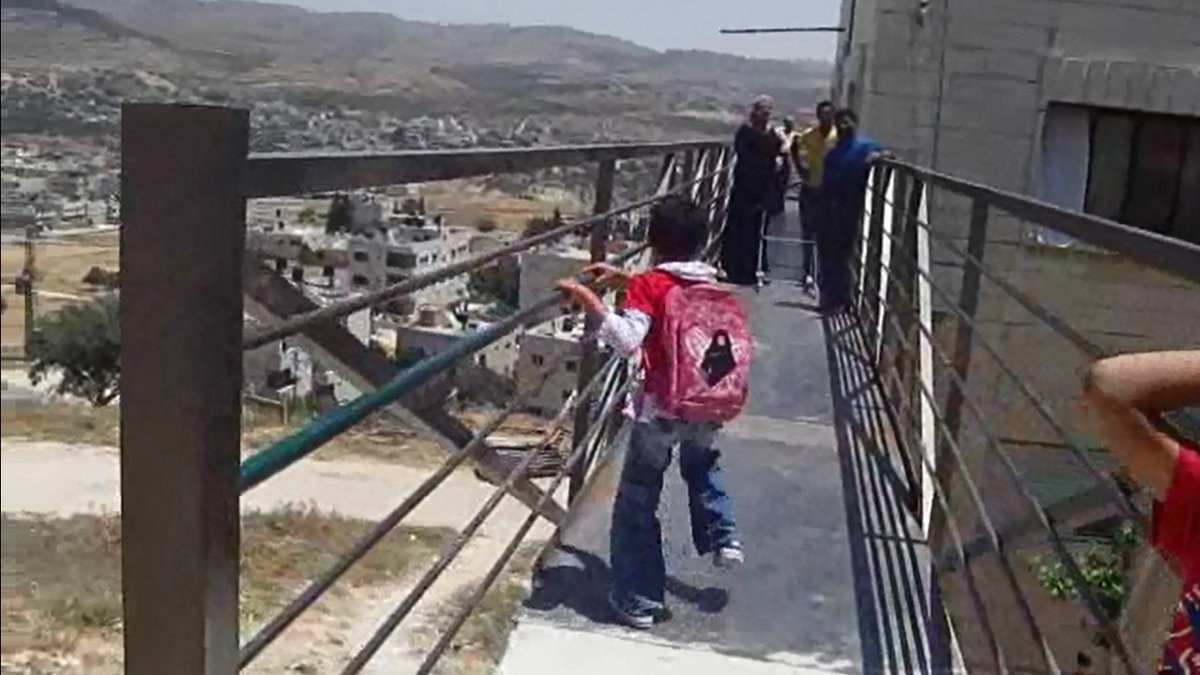
Her father initially sought to install an external electric elevator, but the institutions he approached rejected the proposal due to safety concerns. Determined to find a solution, and drawing on his experience as a blacksmith, he designed an alternative idea: a suspended iron bridge connecting the third-floor apartment directly to street level, since both points were nearly aligned.
He presented the proposal to the YMCA, which welcomed the idea and coordinated with the Housing Rehabilitation Program of the CSC. Engineers and a social worker from the program conducted a site visit to assess the feasibility of the project. Due to the high cost of implementation, the Housing Rehabilitation Program partnered with the YMCA and UNRWA, along with contributions from the local community, including significant efforts from Nour’s family to complete the required work.
This case represents a unique and successful partnership among the three institutions, working together to improve the health, accessibility, and living conditions of families facing complex challenges. It stands as a powerful example of how collaboration, determination, and community support can transform lives.


عدد القراءات: 406


