
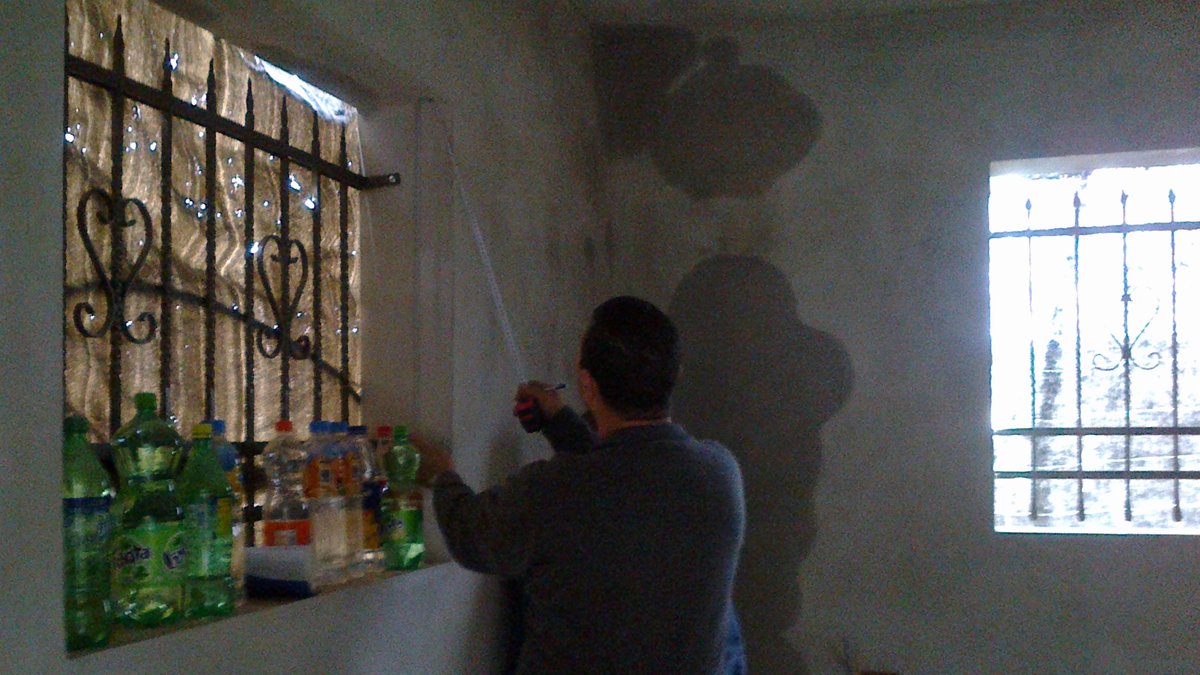
Abu Ammar, a resident of a village south of Nablus, appealed to the relevant authorities in the Palestinian National Authority to help him rehabilitate his home, which lacked adequate living conditions. His request was ultimately referred to the Community Service Center due to the center's reputation and experience in this field, as explained by Osama Bani Odeh, coordinator of the housing rehabilitation program for disadvantaged families, who added “Since the center was established, our program has been one of the most important programs filling a gap that was evident among the authorities responsible for social affairs. We work to the best of our ability, with the support of the local community and funding from support institutions at certain times, to realize the right of citizens to housing that meets basic humanitarian conditions.” Engineer Bani Odeh explained that the center has continued its efforts and utilized its own resources, represented by the support of the local community, including individuals and institutions, and the proceeds from the charity card, which is donated by students enrolled in the community service course. after the end of the project funded by the Arab Fund for Economic and Social Development for the program, which benefited 55 families and 5 schools in the Nablus governorate. The program continued to provide its services by rehabilitating the homes of marginalized families in the city of Nablus and surrounding villages through the Multaqa Al-Khair Fund, carrying out professional interventions in both engineering and social aspects to rehabilitate the homes of more than 22 poor families living in difficult to extremely difficult health and housing conditions. These cases were distributed between the city of Nablus, especially its old town, and 12 villages in the areas surrounding the city and in the Jordan Valley.
As mentioned by Engineer Bani Odeh, the program's interventions included the rehabilitation of sanitary units, the installation of windows and doors, as well as plastering and tiling floors, and treating leaks and moisture, which contributed to improving the living conditions of these families. Regarding the feelings of the beneficiaries of these efforts, the program coordinator quoted one of the beneficiaries from the city of Nablus, a father of a family of six, who said “My family and I felt like we were living on the street because of the worn-out door and broken windows that did not provide us with privacy or protect us from the cold and rain. After what the center did, we feel that our lives have taken a big step forward.”
Mr. Bilal Salama, Director of the Community Service Center, noted that the housing rehabilitation program is one of the center's vital programs that contributes to empowering marginalized families and helping them improve the sanitary conditions of their homes, which in turn improves their social conditions. He also explained that requests for assistance in solving families' housing problems often reveal other problems that families have not sought help for believing that assistance is not possible, which leads the center to take the initiative to help these families in more than one area covered by the center's other programs.
عدد القراءات: 93