
In light of the social, economic, and environmental challenges facing Palestinian society, universities play a vital role in empowering students to engage with community issues. This engagement extends beyond theoretical learning to include practical work with a clear and lasting impact. Within this framework, the center supervises the Community Service Course as both an educational and community-based platform. The course integrates academic learning with community service and is guided by the principles of sustainable development and its seventeen goals, while remaining closely aligned with the Palestinian context and its specific needs.
Course Objective
The course aims to promote a strong culture of volunteering among students. It seeks to transform volunteering from a short-term academic requirement into a meaningful educational experience. This experience strengthens students’ sense of belonging and social responsibility and enables them to contribute directly to the achievement of sustainable development goals through well-planned and purposeful projects.
Implementation Mechanism
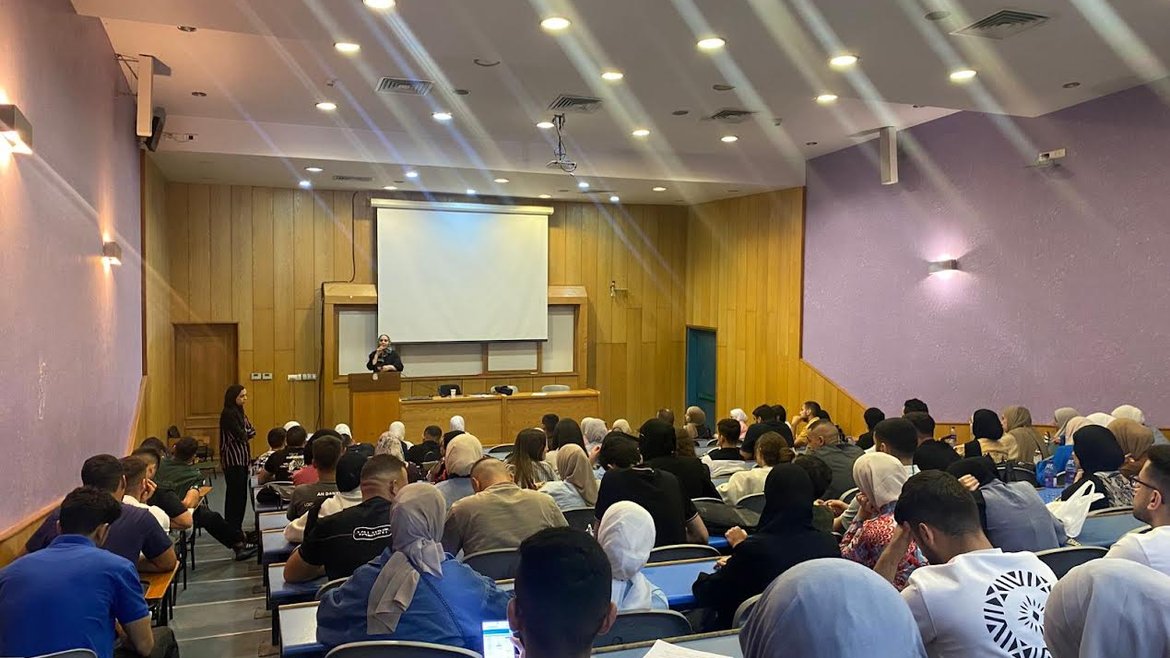
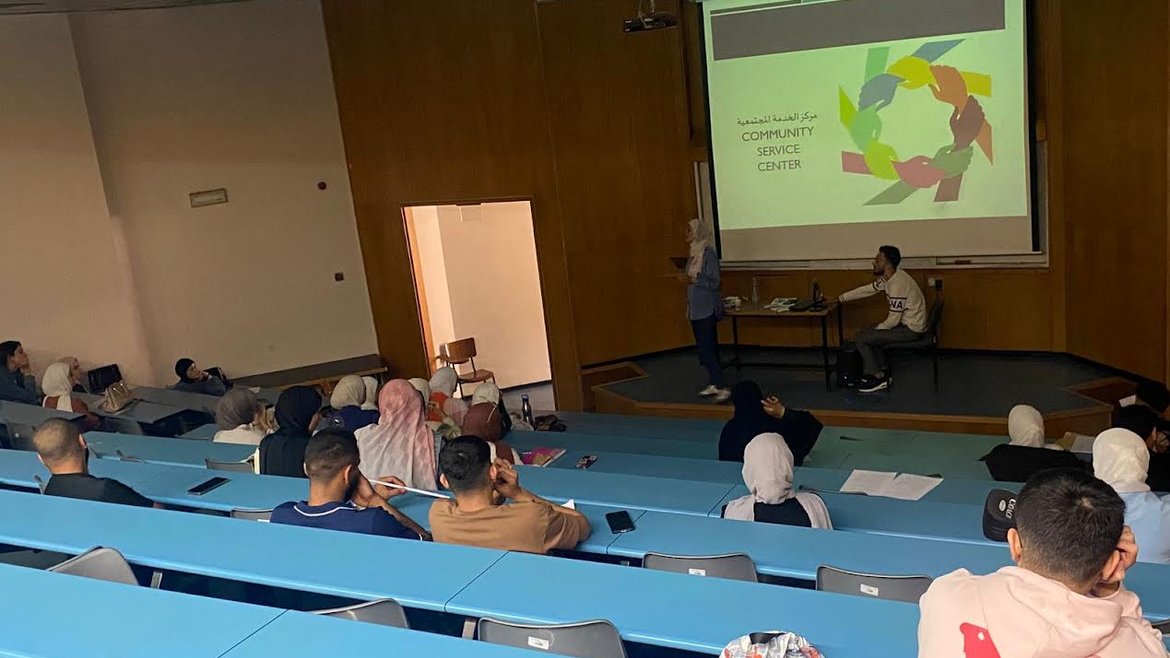
At the start of the course, students attend introductory lectures that highlight the value of volunteer work and its role in advancing development. Students are then placed in civil society organizations and university departments. Each student completes fifty hours of volunteer service during the semester across a range of fields.
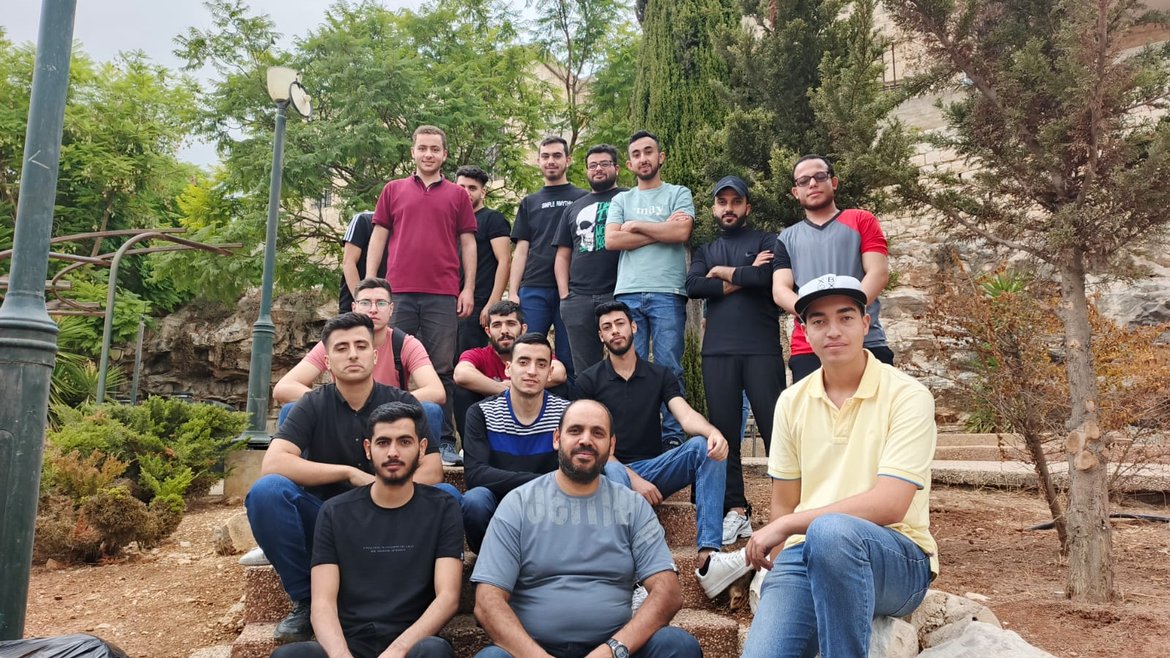
These activities include educational support, such as providing academic assistance to school students, supporting learners with difficulties, preparing educational tools, and improving the school environment. Environmental initiatives are also carried out, including cleaning public spaces, planting trees, recycling solid waste, and raising awareness about agriculture and clean energy. In addition, students engage in social care activities. These include supporting low-income families, rehabilitating housing, caring for the elderly, organizing psychological support activities for orphans, and helping meet their basic needs.
Achievements in Numbers
Over ten years, forty-nine thousand blood units were donated to support patients with kidney disease, thalassemia, and leukemia.
A total of twenty-seven thousand three hundred fifty volunteers contributed eight hundred twenty thousand five hundred volunteer hours across various community fields. More than ten thousand students participated in environmental activities, including cleaning campaigns, tree planting, and the preparation of agricultural seedlings.
The course has grown beyond a graduation requirement to become a meaningful human and community experience. It strengthens national belonging and Palestinian identity while
supporting students’ personal growth. The course helps students develop key skills, including teamwork, leadership, and problem-solving, and opens new opportunities for their professional and social futures.
Many students have expressed the deep and lasting impact of this experience on their lives. They report a renewed perspective on society and a strong motivation to continue volunteering even after completing the course.
The center emphasizes the importance of strengthening partnerships among universities, civil society organizations, and community institutions. These partnerships are essential to expanding the reach and effectiveness of volunteer work in Palestine and aligning these efforts with the global vision of the 2030 Sustainable Development Goals.
Community Service and Sustainable Development Course Syllabus
Course Description
The Community Service and Sustainable Development course serves as a bridge connecting university students with national charitable, civil society, and public institutions. It also plays a role in strengthening students’ commitment to society and familiarizing them with the humanitarian needs that the center helps address by providing assistance (to the extent possible) to alleviate the suffering of target groups, as well as to improve the living conditions of marginalized groups.
The course prioritizes achieving as many of the Sustainable Development Goals as possible within the Palestinian context, not only by raising awareness and providing information about these goals, but also by allowing students to engage in the practical application of various Sustainable Development Goals within their local context, and by implementing programs, projects, and activities aimed at alleviating poverty and hunger, providing medical, therapeutic, and pharmaceutical services to marginalized groups, supporting gender equality and education, and the inclusion of people with disabilities and special needs; the conservation of water and natural resources; raising awareness about alternative and clean energy; caring for the environment, agriculture, and the reuse of solid materials; rejecting discrimination; and working to enhance green spaces and encourage productive agriculture and forestry.
This is achieved by allowing students enrolled in the course to participate at different levels, with alternatives provided for each stage of the course, so that students can fulfill the course requirements under convenient circumstances. This serves the interests of society on the one hand, and helps develop students’ skills and experiences on the other.
The course is divided into three phases:
Students are required to complete 50 hours of community service, divided as follows:
First: Complete 20 hours of service at a charitable organization or association designated by the center based on community needs.
Second: 10 hours of fieldwork in environmental agriculture.
Third: Donating one unit of blood, counting as 10 hours.
Fourth: Planting a tree in a home garden, counting as 10 hours.
There is an alternative system for calculating community service hours according to the following system:
Good Deeds Cards—Categories of Good Deeds Card Booklets
Options Available to Students
Option 1:
One Shekel-category booklet / 10-hour credit / valued at 50 shekels / in lieu of field work or a blood donation
Option 2:
3-shekel booklet / 20-hour credit / Value: 150 shekels / In lieu of field work and a blood donation
Option 3:
Two 3-shekel booklets / 40-hour credit / Value: 300 shekels / In lieu of 40 hours out of 50 hours.
Option 4: Sponsoring an orphan
The student pays 500 shekels for 50 hours—which covers 50 hours of community service
Option 5
30 hours of service at a charitable organization and a Category 3 “Good Deeds” booklet worth 150 shekels.
10 hours of community service are credited in exchange for planting a fruit or forest tree sapling in the home garden, with the requirement to record a video documenting the planting process and ensuring a future irrigation system for the tree.
How Financial Donations Are Used
The financial resources collected are used for charitable initiatives carried out by the Community Service Center, such as: providing grants and loans for college tuition, sponsoring orphans, renovating old homes, providing health and medical support to the poor and needy, providing financial, health, and therapeutic support to people with disabilities, improving housing conditions for the poor, providing financial, food, and medical assistance to the elderly, providing in-kind assistance to those in need, and other initiatives.
In-Person Introductory Lectures for the Course:
* All course material is presented during a single session held on a Saturday during the first, second, and third weeks of each semester.
* The session runs from 8:00 a.m. to 2:00 p.m.
Community Service Center - An-Najah National University